

4 Principles for Designing Human-Guided AI in Supply Chain Planning


In the last post, we challenged a growing assumption in the market. That fully autonomous supply chains represent the natural endpoint of AI adoption.
If that is not the destination, the next question becomes more practical.
How should intelligent agents actually be designed?
For supply chain leaders, this is not just a technology decision. It is an operating model choice. The way AI is introduced into planning processes will determine whether it improves performance or introduces new forms of risk.
The most effective organizations are not slowing down adoption. They are structuring it differently.
Below are four principles that are beginning to define how human-guided AI is deployed in modern supply chain planning.
1. Separate Exploration from Execution
One of the most common mistakes in early AI deployments is tying analysis directly to action.
When intelligent agents are allowed to both generate and execute decisions without checkpoints, speed becomes a liability. Exploration and commitment happen simultaneously, leaving little room for validation.
High-performing organizations take a different approach.
They allow agents to explore broadly, testing thousands of demand, supply, and inventory scenarios across a wide range of assumptions. But they introduce clear decision points before anything becomes operational.
This separation changes the role of AI.
Instead of acting as an autonomous executor, it becomes an experimentation engine. It surfaces options, tradeoffs, and potential outcomes at scale. Humans then determine which path aligns with business objectives.
The result is faster insight without premature execution.

2. Make Risk Explicit
Traditional planning systems tend to present a single answer. A forecast. A plan. A recommendation.
What they often fail to show is uncertainty.
In volatile environments, that gap matters. A plan without visibility into its underlying risk is incomplete.
Human-guided AI introduces a different expectation.
Leaders should not only ask what the recommended action is. They should ask how sensitive that recommendation is to change. What happens if demand shifts. What happens if supply constraints tighten. What happens if assumptions prove incorrect.
This requires moving beyond deterministic outputs toward probability distributions and scenario-based insight.
Intelligent agents are uniquely suited to this. They can evaluate a wide range of variables and surface how outcomes change under different conditions.
The key is ensuring that this information is visible and actionable.
Instead of presenting a single answer, well-designed systems highlight the range of possible outcomes and the conditions that influence them. This allows leaders to understand not just the plan, but the risk profile behind it.
Clarity of risk leads to better decisions.
3. Codify Objectives and Guardrails
AI systems optimize based on the objectives they are given. If those objectives are unclear, incomplete, or outdated, the outcomes will reflect that.
This is where many organizations run into trouble.
They deploy intelligent agents without fully defining what success looks like across the enterprise. Is the priority service level improvement, cost reduction, inventory optimization, or resilience? What tradeoffs are acceptable? What thresholds should not be crossed?
Without explicit guardrails, optimization can drift.
Human-guided AI requires leaders to codify these priorities upfront. Financial goals, service expectations, and risk tolerance must be clearly defined before automation scales.
This is not a one-time exercise. As business conditions evolve, these parameters need to be revisited and adjusted.
When objectives are explicit, intelligent agents perform more effectively within them.

4. Redefine Roles Deliberately
The introduction of intelligent agents does not eliminate the need for planners. It changes what is expected of them.
Historically, much of supply chain planning has been focused on execution. Managing data, adjusting parameters, and responding to exceptions.
As AI takes on more of this mechanical work, the role of the planner evolves.
In a human-guided model, planners become decision architects. They define objectives, interpret scenario outputs, and guide the system based on business priorities. Their focus shifts from managing the plan to shaping it.
This transition does not happen automatically.
Organizations need to rethink how teams are structured, how performance is measured, and how decisions are made. Leaders must invest in elevating the role, not just augmenting the tools.
The goal is not fewer humans in the process. It is more effective ones.
Designing for Speed and Control
These principles reflect a broader shift in how leading organizations are approaching AI in supply chain planning.
Speed is still critical. But it cannot come at the expense of visibility or accountability.
By separating exploration from execution, making risk explicit, codifying objectives, and redefining roles, organizations can move faster while maintaining control.
This is where intelligent digital agents play a meaningful role.
At ketteQ, digital agents powered by the PolymatiQ agentic AI engine are designed to continuously explore thousands of demand, supply, and inventory scenarios while operating within defined objectives and constraints. This approach enables organizations to scale insight without sacrificing governance.
The outcome is not autonomy for its own sake. It is a more deliberate system where speed and control coexist.
Read the Complete Guide
This blog is part of a broader executive perspective on how intelligent agents are reshaping supply chain planning.
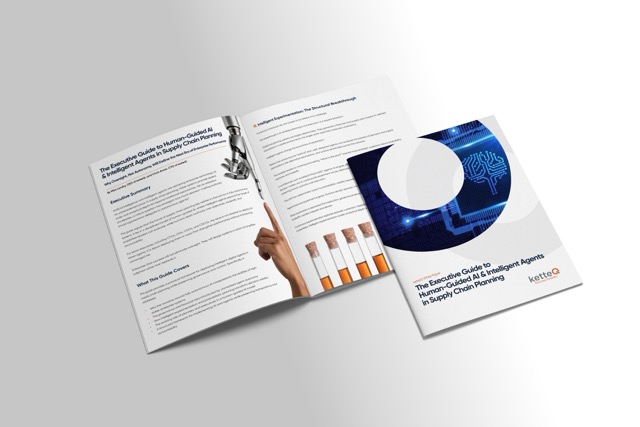
In The Executive Guide to Human-Guided AI and Intelligent Agents in Supply Chain Planning, we explore:
- How governance and performance intersect in AI-driven environments
- Why probabilistic planning is changing decision-making
- What it takes to operationalize human-guided AI at scale
Download the full guide to see how leading organizations are designing AI systems that increase speed, improve visibility, and maintain control.
Learn More
- Part 1: The Autonomy Illusion: Why Fully Autonomous Supply Chains Aren’t the Endgame
About the author
Related articles

ketteCrew Spotlight: Embracing the Next Era of Planning with Ken Wardlaw
ketteCrew Spotlight: Embracing the Next Era of Planning with Ken Wardlaw