
Is Your Supply Chain AI Built In or Just Bolted On?


Why the architecture behind your AI matters more than the capabilities you see in a demo.
Artificial intelligence is becoming a standard feature in supply chain planning software. Vendors promise smarter forecasts, faster decisions, and greater visibility. But as organizations race to adopt agentic AI, one critical question is being overlooked: Is the AI actually built into the planning architecture, or has it simply been bolted onto technology that was never designed for it?
The distinction has significant implications for how supply chains respond to disruptions, make decisions, and adapt to change. As ketteQ CTO Chris Amet and Executive Advisory Board Chairman Rick McDonald explain in their white paper, Bolted On vs. Built In, the architecture beneath AI determines not only what it can accomplish today, but what it will ever be capable of doing.
The Problem with Bolting AI onto Legacy Planning Systems
Traditional supply chain planning systems were designed for a different era. Planning cycles were periodic, data moved between disconnected systems, and complex calculations often required hours to complete. These systems served their purpose, but they were not designed for AI agents that need to reason, experiment, and act continuously.
Today, many software providers are adding AI interfaces to existing platforms. While the result may look impressive, the underlying architecture often remains unchanged. The AI might interpret questions, retrieve information, or generate recommendations, but if the planning engine operates independently, the AI inherits its limitations.
Consider a supply chain leader asking how a supplier disruption will affect inventory, production capacity, and customer commitments. A bolted-on AI may summarize existing reports, but answering an unfamiliar question could require additional planning runs, data transfers, or predefined workflows.
A smarter interface does not automatically create a smarter planning system. When conditions change faster than traditional planning cycles can respond, those limitations become increasingly consequential.

Why a Great AI Demo Doesn't Tell the Whole Story
Supply chain AI demonstrations showcase what a platform does best. Questions are anticipated, scenarios are prepared, and data is staged to illustrate specific capabilities. The experience can be seamless, making the AI appear capable of handling virtually any planning challenge.
But real supply chains rarely follow a script. Demand shifts unexpectedly, suppliers miss commitments, tariffs change, and production constraints emerge without warning. What happens when someone asks a question the AI wasn't prepared to answer?
Can it reason through an unfamiliar scenario using live data? Can it evaluate competing constraints and produce an answer in seconds? Or does the question require additional configuration, a new report, or a follow-up demonstration?
These moments reveal the difference between bolted-on and built-in AI. The real test isn't how well AI answers a prepared question. It's what happens when you ask one nobody expected.
What Makes AI-Native Architecture Different?
AI-native architecture changes how artificial intelligence interacts with planning systems. Rather than interpreting outputs through a separate interface, AI can directly access the underlying data, planning logic, and decision-making capabilities. This allows it to reason through unfamiliar questions, evaluate alternatives, and execute actions as conditions change.
At ketteQ, this approach is foundational to Quintus™, powered by PolymatiQ™, the company's patent-pending agentic solver technology. PolymatiQ™ explores the solution space and returns optimal answers in seconds, enabling Quintus™ to reason through complex planning questions without predefined scenarios.
The result is Free-Range AI™. Fully governed.
Importantly, AI-native architecture doesn't require organizations to abandon existing enterprise systems. Quintus™ operates above ERP and planning platforms while maintaining its own native reasoning and solver capabilities. Existing systems remain valuable sources of record without dictating the speed or scope of AI decision-making.
This distinction is especially important for organizations seeking advanced AI capabilities without replacing their entire technology infrastructure.
From Periodic Planning to Continuous Decision-Making
Legacy architecture becomes particularly limiting when organizations attempt to move from periodic planning to continuous decision-making. Traditional processes rely on scheduled cycles where teams gather information, run scenarios, review results, and make adjustments. By the time decisions are implemented, conditions may have already changed.
Agentic AI introduces a different operating model. Instead of waiting for the next planning cycle, AI agents can continuously evaluate conditions, explore possible responses, and take appropriate action within established governance boundaries.
But this requires architecture capable of rapid, repeated reasoning. If each planning calculation takes hours, an AI agent can explore only a limited number of possibilities. When calculations take seconds, it can evaluate far more alternatives as conditions evolve.
Solver speed and architectural integration aren't simply technical specifications. They directly influence how quickly organizations can respond to uncertainty.
The faster a system moves from information to decision to action, the more adaptable the supply chain becomes.
The Question Every Supply Chain Leader Should Ask
For organizations evaluating AI-powered planning solutions, the conversation must move beyond features and demonstrations. The most important question may also be the simplest: How is your AI actually connected to your planning system?
Understanding that connection reveals whether AI can access live information, reason beyond predefined workflows, and support autonomous execution.
As supply chain complexity increases, organizations need more than AI to make existing processes look smarter. They need architecture that enables fundamentally different ways of planning and operating.
The future of supply chain AI won't be determined by who has the most impressive demonstration. It will be determined by what's underneath it.
Go Deeper: Bolted On vs. Built In
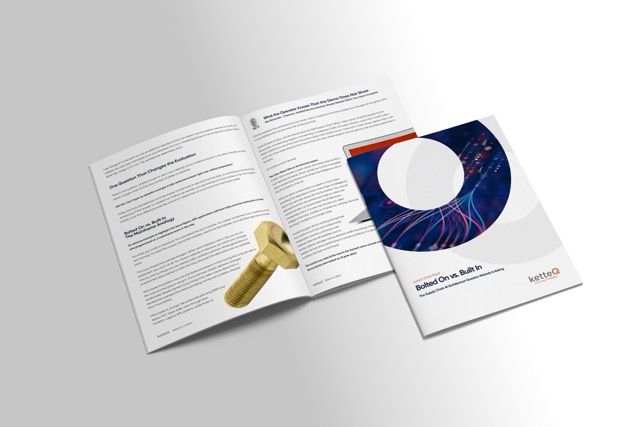
In their white paper, Bolted On vs. Built In: The Supply Chain AI Architecture Question Nobody Is Asking, Chris Amet and Rick McDonald explore why architecture is the defining factor in the future of supply chain intelligence.
Download the white paper to discover the questions every supply chain leader should ask before investing in AI.
About the author
Related articles

ketteCrew Spotlight: Embracing the Next Era of Planning with Ken Wardlaw
ketteCrew Spotlight: Embracing the Next Era of Planning with Ken Wardlaw