
NVIDIA, AI Agents, and the Case for Human Oversight in Supply Chain Planning


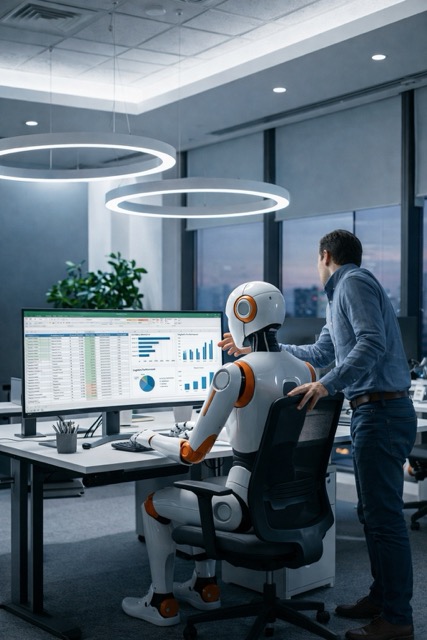
Even as AI agents promise to transform enterprise operations, Nvidia CEO Jensen Huang offered a surprisingly grounded take at a recent Cisco event: AI won't replace enterprise software, it'll use it. Agents, he argued, are tools users, not autonomous decision-makers.
Speaking recently at a Cisco-hosted event, Nvidia CEO Jensen Huang pushed back on the idea that AI will replace enterprise software altogether. Software, Huang argued, is a tool, and AI agents will use enterprise applications the way humans do today, just faster and more broadly. The implication is important: even in an agent-driven future, systems don’t disappear. Control, structure, and direction still matter.
That perspective lands squarely in the middle of one of the most important debates facing enterprises today, especially in supply chain planning.
This blog is the first in a four-part series exploring why human oversight remains essential as AI and intelligent agents reshape supply chain planning.
Agents Are Coming Fast. Autonomy Is Not Guaranteed.
The vision of AI agents running freely across enterprise systems is compelling. Agents that can access data, trigger workflows, and make decisions promise massive efficiency gains. It’s no surprise that the “agentic layer” is quickly becoming the next battleground across enterprise software.
But as recent market reactions and technical assessments make clear, these agents are not ready for unchecked autonomy, particularly in environments where mistakes cascade quickly, and consequences are severe.
Supply chain planning is one such environment.
Here, decisions directly affect:
- Revenue realization and missed shipments
- Inventory levels and working capital
- Service commitments and penalties
- Customer trust and brand reputation
In this context, the question isn’t whether agents will play a role; it’s how they’re governed. A single unchecked agent decision - say, adjusting safety stock levels based on incomplete demand signals - can trigger millions in excess inventory or costly stockouts across an entire network within hours.
The Real Risk Isn’t Agents. It’s Unsupervised Decision-Making.
The most dangerous misconception about AI agents is that greater intelligence automatically leads to better decisions.
It doesn’t.
Agents can move fast. They can explore more possibilities than any human ever could. But without context, priorities, and guardrails, they can just as easily optimize in the wrong direction, confidently and at scale.
This is why Huang’s framing matters. If software is a tool, then agents are users of tools, not independent decision-makers. Tools require intent. They require constraints. And they require accountability.
Unchecked autonomy isn’t innovation, it’s exposure.
Why Human Oversight Is a Force Multiplier
There’s a persistent myth that keeping humans involved slows AI down. In reality, the opposite is true when systems are designed correctly.
AI agents excel at:
- Exploring vast numbers of scenarios
- Processing complex constraints
- Surfacing probabilities, patterns, and tradeoffs
Humans excel at:
- Defining objectives and priorities
- Setting acceptable risk thresholds
- Balancing competing business goals
- Owning outcomes
The most effective supply chain planning systems will not replace human judgment. They scale it. Consider demand planning: An agent can simulate 10,000 forecast variations overnight, stress-testing each against capacity constraints and lead time variability. But it takes a human planner to recognize that the 'optimal' plan assumes supplier reliability that doesn't match recent performance - and to steer the system toward a more resilient alternative.
Oversight doesn’t mean micromanagement. It means direction.
What Modern Supply Chain Planning Actually Requires
In high-stakes environments, leaders don’t want a single “optimal” answer. They want visibility into:
- What could happen
- What’s likely to happen
- What risks and tradeoffs are embedded in each option
Planning systems should expand decision intelligence, not collapse.
This is where many visions of “super agents” fall short today. The scaffolding required for trust: controls, explainability, boundaries, and human guidance, is still being built.
Supply chains can’t afford to wait for perfection.
This Is Where ketteQ Was Built to Operate
ketteQ was designed around a simple reality: supply chain planning is a high-impact, high-accountability function. It demands both massive computational power and human judgment.
Instead of producing a single answer, ketteQ’s PolymatiQ™ agentic AI engine deploys intelligent digital agents that continuously experiment across thousands of demand, supply, inventory, and customer commitment scenarios. These agents explore alternatives, surface tradeoffs, and reveal probabilities at machine speed while humans guide the system by setting objectives, adjusting constraints, and steering decisions toward what matters most.
ketteQ inverts the traditional planning paradigm. Instead of asking planners to validate a single 'optimal' plan generated by AI, we give them an exploration engine. PolymatiQ runs thousands of intelligent agents in parallel - each testing different assumptions about demand, supply, and constraints. Planners don't approve or reject. They experiment, compare, and choose, guided by AI-surfaced tradeoffs and probabilities.
This is where ketteQ shines:
- Multi-agent scenario exploration through intelligent experimentation
- Probabilistic outcomes that expose risk and tradeoffs, not just “the plan.”
- Humans steer experiments, adjust constraints, and choose paths
- Not “approve the plan,” but shape and guide the system
AI does the heavy lifting. Humans own the decision.
The companies that win won't be those that build the most autonomous agents. They'll be those that create the best human-AI partnerships - systems where AI explores every possibility, and humans direct toward the right one. That's not a hedge against AI. That's how you make it work.

The Executive Takeaway
The future isn’t a single super-agent running loose across the enterprise.
It’s many intelligent digital agents operating within clear boundaries, guided by human intent, and accountable to tangible business outcomes.
That balance, speed with oversight, intelligence with judgment, isn’t a compromise. It’s the only model that scales safely in environments where the stakes are simply too high.
And it’s how modern supply chains should plan for every possibility.
To explore how intelligent digital agents can support human-guided supply chain planning, visit ketteQ’s agent page.
About the author
Related articles

ketteCrew Spotlight: Embracing the Next Era of Planning with Ken Wardlaw
ketteCrew Spotlight: Embracing the Next Era of Planning with Ken Wardlaw