

Your o9 Investment Was the Right Decision: Here’s Why It Needs an Upgrade


The Early Wins That Mask a Growing Problem
When many organizations selected o9, it delivered meaningful early improvements. Data became more unified. Visibility increased. Planning workflows became more structured and repeatable. For executive teams, it represented a smart, forward-looking investment.
Over time, however, the pace of progress often begins to slow. Scenario runs take longer. Planners turn to spreadsheets because they can model ideas faster. Customizations accumulate and become harder to maintain. The system gradually shifts from being a decision engine to serving as a structured data hub that supports offline analysis.
This pattern is common among companies operating in fast-moving markets. It does not reflect a poor technology choice. It reflects a shift in business needs that outpaces the original architecture behind the system.

When Complexity Outpaces Your Planning System
Modern supply chains operate with greater volatility, larger data sets, and tighter decision windows than ever before. Traditional single-pass solvers cannot keep up with the constantly moving environment. As these gaps widen, planners make decisions outside the system because they need speed and flexibility.
This creates a cycle where the platform remains useful for data management but plays a decreasing role in daily decision making. Confidence erodes and adoption declines. The system performs as designed, yet the environment demands more than deterministic models can deliver.
The Plateau Is Not a Failure of the Decision You Made
Executives often misinterpret this plateau as a sign that the original system selection was flawed. In reality, the system still performs its foundational role well. What changed was the world around it. The business grew more complex. Market volatility increased. Decision timelines shortened dramatically.
Organizations typically respond in one of three ways. Some stay the course and accept flat performance. Others invest heavily in consulting to tune the system. Some attempt a costly rip and replace. Each path brings risk, time, or limited returns.
There is a better option. Enhance the system rather than replace it.

The Adaptive Layer o9 Was Missing
PolymatiQ introduces exactly what o9 environments need to break through the plateau. It operates silently behind the scenes as a headless, adaptive AI engine that integrates cleanly with your existing workflows. Planners continue using the o9 interface. Workflows stay the same. No retraining is required.
What changes is the intelligence beneath the surface. PolymatiQ runs unlimited scenarios in real time, performs multi-pass probabilistic solving, and adapts dynamically as conditions shift. Decisions become faster. Recommendations become more accurate. The system finally keeps pace with the business again.
A Foundation Ready for More Value
o9 remains a strong foundation. It brings structure, governance, and visibility to your planning environment. PolymatiQ enhances that foundation by delivering the speed and adaptability the system was never designed to achieve on its own.
The results speak for themselves. Organizations using PolymatiQ on top of their existing planning systems have achieved rapid improvements in utilization, waste reduction, and agility. These gains appear not in years, but in weeks, because the underlying system does not need to be replaced. It simply needs to be empowered with modern computational intelligence.

The Value You Hoped for Is Still Within Reach
Your decision to invest in o9 was the right one. The environment moved faster than the system could evolve. PolymatiQ allows your teams to recover the value that has been locked inside your planning system while protecting the investment you already made.
Download the Full Guide for a Deeper Look
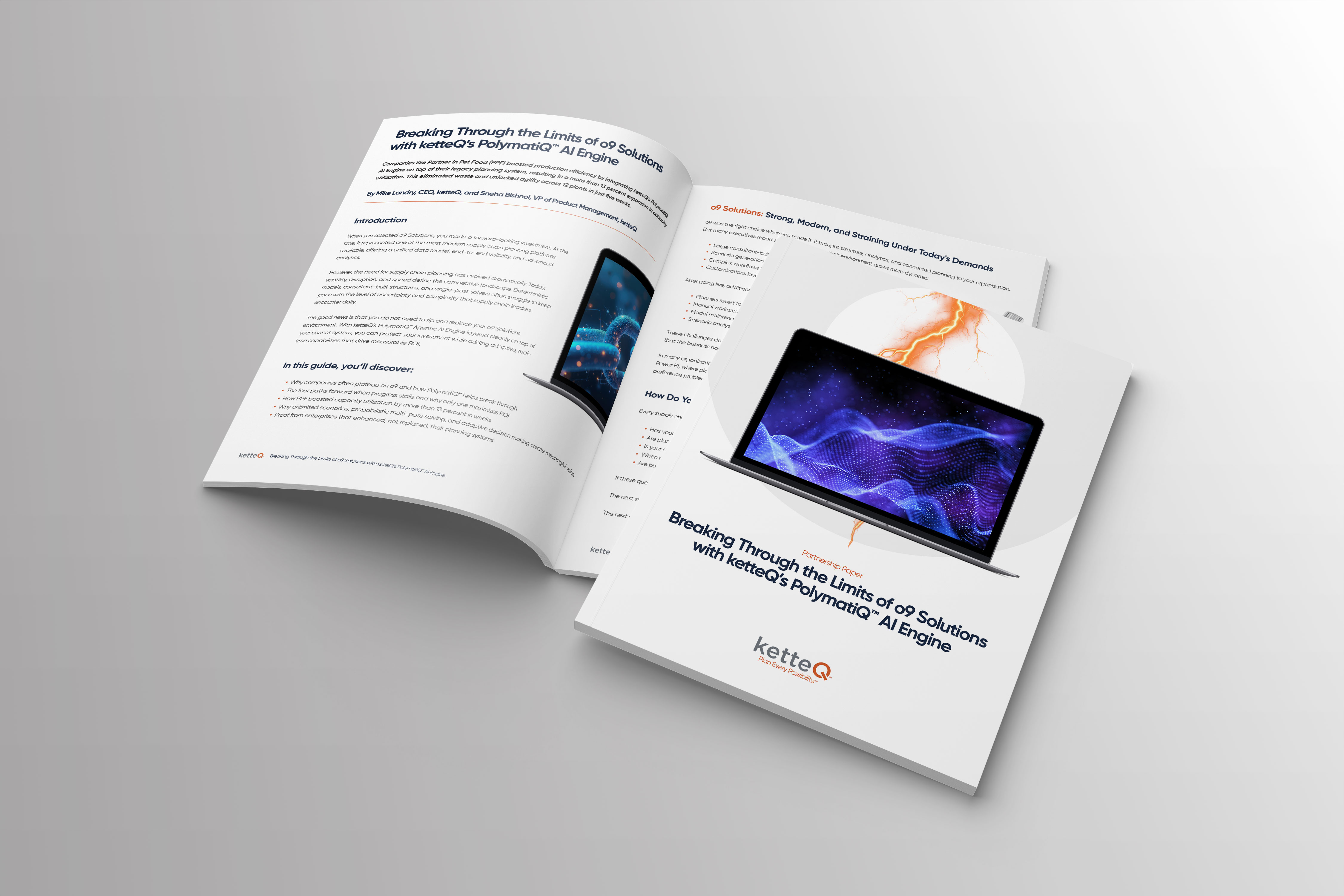
To explore how PolymatiQ activates new value inside your current o9 environment and to see real examples of organizations breaking through their performance plateau, download the complete white paper. It provides practical insights, use cases, and guidance to help you determine your next steps.
About the author