

From Planning Cycles to Intelligent Systems: Why 2026 Is a Breakthrough Year


For years, supply chain leaders have shared a vision of what better decision making could look like. They wanted supply chains that could sense change earlier, evaluate options faster, and adapt continuously rather than waiting for the next planning cycle. What held them back was not ambition or understanding. It was feasibility. The systems and decision models available were never designed to operate continuously under uncertainty.
In 2026, that constraint finally lifts. This year represents a breakthrough not because supply chains are suddenly under more pressure than before, but because organizations can now operate them as intelligent systems rather than reactive operations. What once required extraordinary effort is now achievable at scale.
The Value Planning Cycles Delivered and Where They Stop
Traditional planning cycles played a foundational role in building modern supply chains. Monthly and quarterly plans brought discipline, coordination, and accountability. They helped organizations align demand, supply, inventory, and production decisions across complex global networks. For a long time, this approach worked well.
Planning cycles were designed for a world where change was gradual and variability was bounded. Assumptions could be frozen long enough for plans to remain relevant. Today, conditions evolve continuously. Demand signals shift faster than planning cadences. Supply constraints emerge and resolve more quickly. Financial pressure requires earlier and more nuanced trade off decisions across service, cost, and working capital.
The limitation is not that planning cycles are flawed. It is that they were never intended to operate continuously. They excel at committing to a plan, but struggle to adapt that plan as conditions change between cycles. As a result, teams spend more time reforecasting, reconciling data, and explaining variances than evaluating options and making forward looking decisions.

Volatility as a Design Input
One of the most important mindset shifts taking hold in 2026 is how leaders view volatility. Instead of treating uncertainty as something to eliminate or buffer away, leading organizations are treating it as a design input. Variability no longer needs to be ignored until the next planning run. It can be modeled, evaluated, and acted on directly.
This shift changes decision making in a meaningful way. Leaders no longer need to ask which forecast is correct. They can ask which decisions remain effective across a range of plausible outcomes. Rather than delaying action until certainty improves, organizations can move earlier with a clearer understanding of risk, upside, and trade offs.
Advances in cloud platforms, data integration, and probabilistic modeling make this possible. Intelligent systems can now explore thousands of possible futures and evaluate how decisions perform across uncertainty rather than optimizing to a single expected outcome.
A Change in Executive Expectations
As these capabilities mature, executive expectations are evolving. Boards and leadership teams are placing less emphasis on whether the organization executed a plan exactly as written. Instead, they are focused on whether the organization can adapt confidently as conditions evolve.
This does not mean abandoning accountability. It means redefining it. Success is no longer measured solely by forecast accuracy or adherence to a static plan. It is measured by decision quality, response speed, and the ability to balance service, cost, margin, and working capital as conditions change.
When supply chains operate as intelligent systems, leaders gain earlier visibility into emerging trade offs. They see not only what is happening, but what options are available and what each option implies. Decision making becomes calmer, faster, and more deliberate.

What Becomes Possible in 2026
The shift from planning cycles to intelligent systems unlocks a different operating experience. Instead of periodic snapshots, leaders work with continuously updated views of demand, supply, inventory, and financial impact. Instead of debating whose numbers are right, teams evaluate scenarios together and align on which risks they are willing to accept. Instead of reacting after issues escalate, organizations address them while multiple paths forward are still available.
This shift is enabled by planning platforms like ketteQ, where decisions across the supply chain operate on a shared data model. At the core of ketteQ’s approach is PolymatiQ™, an agentic AI engine purpose built for adaptive supply chain planning. PolymatiQ runs thousands of scenarios continuously, evaluating how changes in demand, supply, capacity, or constraints ripple across service, cost, and working capital.
Rather than asking for a single best plan, PolymatiQ helps organizations understand which decisions remain effective across uncertainty. Intelligent agents operating on top of the platform continuously sense change, evaluate options, and surface decision ready trade offs for human leaders. Planners and executives define intent and priorities while the system manages complexity at scale.
A Foundation for Intelligent Systems
2026 will not be remembered as the year planning disappeared. It will be remembered as the year planning evolved. Planning cycles remain essential for setting direction and committing resources. What changes is what happens between those cycles.
Intelligent systems fill that gap. They continuously sense, evaluate, and adapt so plans remain relevant as conditions change. Platforms powered by agentic engines like PolymatiQ do not promise perfect prediction. They provide preparedness. They give leaders confidence not because the future is known, but because many possible futures have already been considered.
In the next part of this series, we will look inside the intelligent supply chain and define the four core capabilities that make this new way of operating possible.
Read the Full Guide
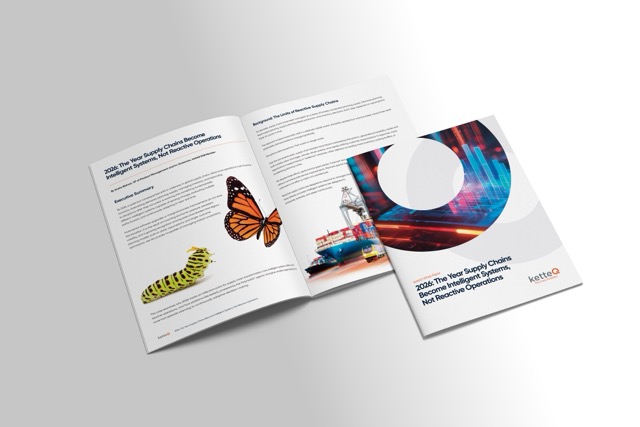
Download the complete guide, 2026: The Year Supply Chains Become Intelligent Systems, to understand how leading organizations are moving from reactive planning to continuously adaptive decision-making.
About the author
Related articles

ketteCrew Spotlight: Embracing the Next Era of Planning with Ken Wardlaw
ketteCrew Spotlight: Embracing the Next Era of Planning with Ken Wardlaw